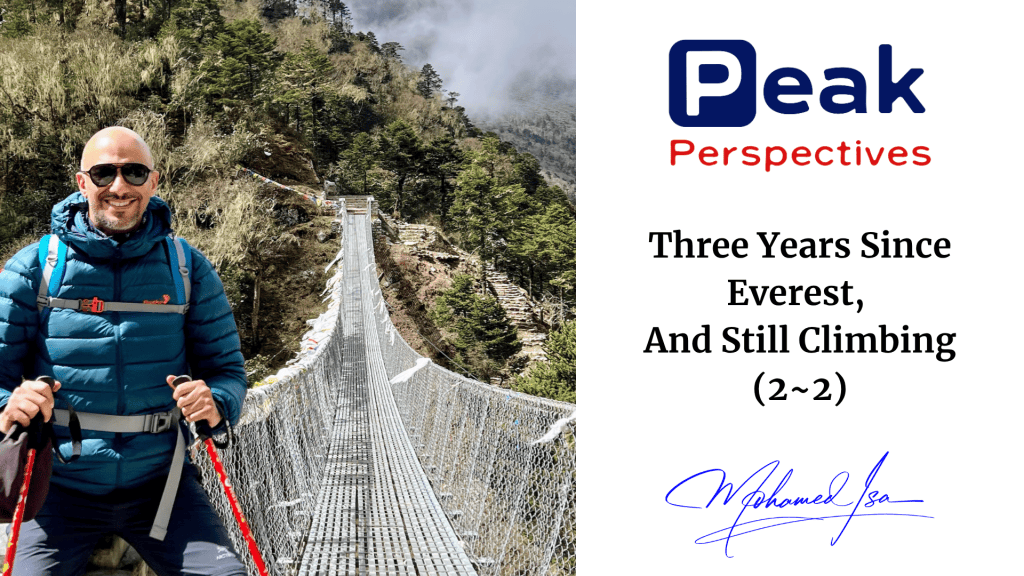
Part 2: Leadership, Legacy, and the Summits Still Ahead
New to this story? Start with Part 1.
Lessons on the Trail (Leadership from the Backline)
Throughout my life, from my school years to my time at Unilever, serving as a CFO and eventually serving on boards, I’ve witnessed many leadership styles.
And I’ve always believed:
Leadership isn’t a title. It’s a character. It’s action.
But this belief was most powerfully reinforced on the trek to Everest Base Camp.
On our journey, we had three porters. They carried our duffel bags; each porter carried two bags, each bag weighing around 15 kilograms. But more than that … they carried the spirit of leadership without ever using the word.
The clearest example in my mind?
Ashok.
Ask Mai Al Raeesi from Bahrain how she made it to Base Camp, and she’ll give you many reasons. But one of the biggest, she’ll tell you, was Ashok.
He motivated her all the way. When she struggled, he didn’t step back. He stepped up. At times, he carried her backpack on top of the two 15-kg duffel bags already strapped to his back.
He never complained. He never lost patience. He never let go of his smile.
That … is true leadership.
Helping someone else reach heights they never imagined. Quietly. Humbly. Relentlessly.
The mountain didn’t change my definition of leadership. It made it unshakable.
Leadership isn’t about being at the front. It’s about walking beside someone and making sure they don’t fall behind.
From the Summit to the Stage (Leading Through Stories)
Everest Base Camp (EBC) reinforced the leadership principles I hold dear, those that align my head and heart with humility, service, and trust.
If EBC reshaped anything, it wasn’t my core values, it was my speaking offering.
Since that journey, my Everest Leadership Speech has inspired thousands of audience members across the Gulf, in both the public and private sectors. Most recently, on 17 April 2025, I delivered an extended version to the Royal University for Women in Bahrain MBA students. It moved them, motivated them, and reminded them that leadership is not reserved for people with corner offices or formal titles.
I believe you don’t need a position to lead. Sometimes, you only need to show the way and empower others to walk it. Provide them with direction. Support them with resources. Then step aside … and let them climb.
True leadership is not about visibility, it’s about responsibility.
From Doubt to Drive (The Mindset That Shifted)
My expedition to Everest Base Camp reinforced a belief I was already living into: self-reinvention.
Even before Everest, I had begun rewriting the script.
I didn’t wait for certainty.
I didn’t choose the safe, familiar path.
I chose growth, and with it came discomfort, doubt, and risk.
The shift was already underway:
- I stopped waiting to feel “fully ready.”
- I started trusting progress over perfection.
- I made decisions that raised eyebrows, not just comfort levels.
- I leaned into challenges that stretched me, even when the outcome was unclear.
Everest didn’t start the transformation.
It revealed how deeply it had already taken root.
It reminded me of a mantra I’ve quietly followed for years: Just do it.
Yes, the Nike slogan. But also, a personal philosophy.
I’ve been to other mountains before, but it wasn’t until Everest entered the story that people really noticed. That name carries weight. It sparked endless questions:
“Why are you doing this?”
“Isn’t it risky?”
“You should be careful.”
“Find another hobby.”
My internal response?
“Why not?”
And when I get these comments, I answer with logic and a smile:
If I’m climbing a mountain, I must be fit, right?
“Yes.”
Is being fit a good thing?
“Yes.”
To go on these expeditions, I need money, right?
“Yes.”
So, I need to work harder and generate more income.
Is that a good thing?
“Yes.”
Conversation over.
What I don’t explain is the personal and spiritual growth I experience up there. The silence of the mountains answers questions I didn’t know I was asking. Standing beneath something ancient makes me feel small but whole.
I don’t argue with the doubters.
I simply keep climbing.
Sometimes the best way to lead is not to defend your path, but to walk it with conviction.
Mountains That Followed (A Journey of Unexpected Creation)
When I registered for the Everest Base Camp expedition, I wanted to test my physical and mental limits. Then, the thought crossed my mind: maybe there’s a speech in this … perhaps even a book.
But looking back now, I’m quietly amazed by how much this single experience has transformed me and what I do.
It didn’t just stay on the mountain.
It followed me home and unfolded into so much more:
- Created the Everest Leadership speech
- Developed a full leadership workshop trainee guide
- Designed the “What’s Your Everest?” postcard, now one of four inspirational postcards I give away
- Created Everest-inspired group games for workshops
- Published a leadership-themed coloring book
- Minted a custom metal coin, which I gift to one outstanding participant at every speech
- Returned to my old hobbies of collecting stamps and coins, starting with Everest, then expanding
- Began collecting Everest publications dating back to the 1950s
- Started working on a documentary film about our EBC expedition
- Appeared on podcasts and TV interviews to share what the mountains taught me
- And now, I’m pursuing a PhD at Kathmandu University, researching Leadership in the Mountains
All this, sparked by a sponsored Instagram ad… and a “Why not?”
I don’t say this to impress.
I say it to remind myself and others of what’s possible when you say yes to the unknown.
Leadership is not just about what you build for others, it’s also what you unlock in yourself.
The Summit Left Undone (Unfinished Business)
The subject of unfinished business brings a long sigh.
As extraordinary as my Everest Base Camp expedition was, there are still experiences I long for, things I hope to fulfill in the years ahead.
For starters, we didn’t trek to Kala Patthar, the viewpoint known for offering the best view of Everest, the same majestic angle featured on Nepali banknotes. I deeply missed that.
Second, I wish we had more time at Base Camp itself, to meet the climbers preparing for their summit push. I wanted to connect with them, learn from them, and be inspired by them. But time, as always, was limited.
Third, I returned to Lukla by helicopter.
My friend Ahmed Salman from Bahrain asked if we’d consider it, he had never ridden in one before. It was a great experience, but part of me longs to walk the trail back to Lukla, to absorb it one more time, with more reflection and less urgency.
We also missed visiting the Pyramid, the high-altitude scientific weather research center, something I had hoped to see.
And then there’s the Everest View Hotel, the highest five-star hotel in the world, perched above Namche Bazaar. I want to stay there, sip tea, and stare out at the mountains that changed me.
The list goes on.
But maybe that’s a good thing.
Unfinished business means unfinished discovery.
And that gives me a reason to return, not just to the Himalayas… but to myself.
Great leaders know that not everything must be completed to be meaningful. Some goals are meant to stay open, to keep us moving.
Next Peak in Sight (The Mission Continues)
Everest Base Camp wasn’t the finish line.
It was the starting point.
I’m now on a mission to complete the Seven Summits Challenge, climbing the highest peak on every continent.
So far, I’ve reached the summits of:
– Mount Kosciuszko (Australia, January 2024)
– Mount Kilimanjaro (Tanzania, Africa, July 2024)
Next on my list: Mount Elbrus in Russia.
I’ve already started preparing mentally, strategically, and spiritually.
Since returning from Kilimanjaro in July 2024, I’ve been studying Elbrus: the routes, the risks, the rhythm of the climb.
Am I fully ready?
Not yet.
Physically, I’m a bit behind schedule.
But I plan to catch up fast, with focus, with discipline, and with the fire Everest lit in me three years ago.
The target summit window is August 2025.
And I plan to be there, boots laced, heart open, eyes on the sky.
Update: Read how that climb unfolded in Tears on Elbrus.
Leadership is a lifelong ascent. Each mountain teaches something new, but only if you keep showing up.
The Mental Everest (Final Reflection)
I walked into the unknown when I left my role as Chief Financial Officer of a publicly listed company in December 2015.
It wasn’t easy.
But it was necessary.
The best person to describe my mental state back then?
Dr. Martin Luther King Jr., who once said:
“Faith is taking the first step even when you don’t see the whole staircase.”
I first read that quote on a souvenir in Washington, D.C., in July 2015, just as I was preparing to leave corporate life behind to step fully into a life of speaking, writing, and traveling.
That quote became a compass.
And it still is, whether I’m standing at the base of a real mountain or facing my own mental Everest.
So, to anyone out there climbing their toughest internal challenge, feeling exhausted, unsure, or overwhelmed:
You don’t need to see the summit.
You just need to keep climbing.
Lead yourself first. Then lead others by the altitude of your example.
First published in Peak Perspectives, Mohamed’s LinkedIn newsletter, Edition #5, May 20, 2025.
Bring the Everest story to your leaders
Mohamed’s Everest Leadership keynote turns lessons like these into a working session for executive teams, conferences and leadership retreats.

