The Peak Leadership Model
From One Hour to Six Months, on One Model
Every program grows from the Everest Leadership keynote and rests on the same six camps of leadership. Choose the depth your leaders need.
Why promotion exposes leadership gaps
Organizations rarely promote people who are failing. They promote the best engineer, the strongest salesperson, the analyst whose numbers are always right. Then they discover, sometimes within months, that the capability that earned the promotion is not the capability the new role requires.
Leadership gaps rarely show when conditions are easy. They show when time is short, information is incomplete, the team disagrees, and the consequences are real. Mohamed’s programs put leaders into those conditions before the workplace does.
Altitude does not create weakness. It exposes it.
The Peak Leadership Model
Leadership is climbed one camp at a time
Climbers acclimatize at each camp before they go higher. Skip one, and the mountain finds out. The Peak Leadership Model applies the same logic to leadership: six altitudes of challenge, each adding scope and complexity, each built on the camps below it. Mohamed developed the model after speaking at a conference in Oman, and his PhD research at Kathmandu University continues to shape it.
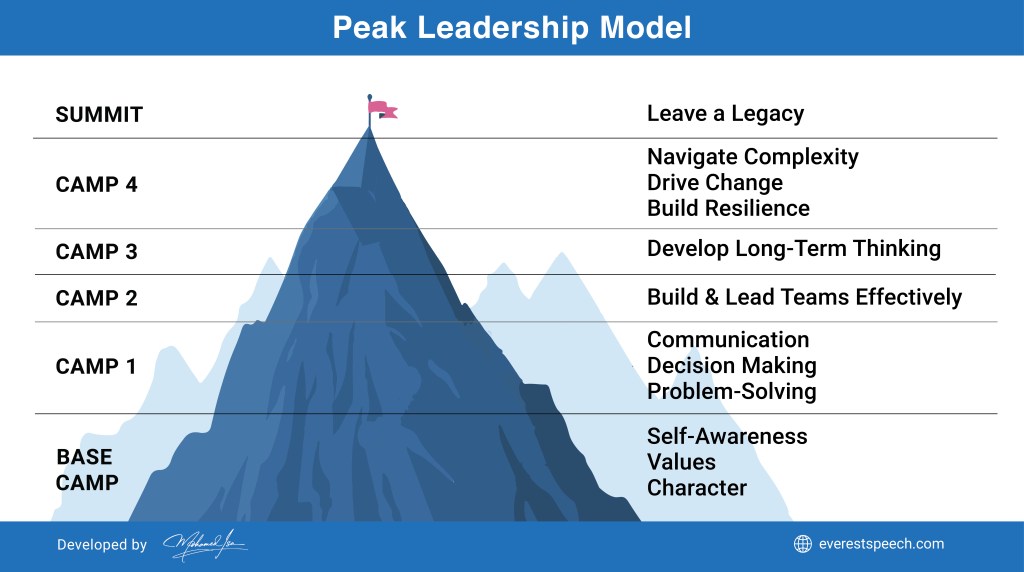
| Camp | The leadership challenge | When it is missing |
|---|---|---|
| Summit Leave a Legacy | Building an institution that performs without the leader | The organization stalls when the leader is absent |
| Camp 4 Navigate Complexity, Drive Change, and Build Resilience | Leading where outcomes cannot be controlled, only shaped | Plans outlive the conditions they assumed |
| Camp 3 Develop Long-Term Thinking | Moving from operational management to strategic leadership | Short-term results consume long-term position |
| Camp 2 Build and Lead Teams Effectively | Moving from individual contribution to collective performance | Every decision routes through one person; people stop speaking up |
| Camp 1 Communication, Decision-Making, and Problem-Solving | Turning ambiguous information into decisions others can understand and execute | The same direction is heard differently in every unit |
| Base Camp Self-Awareness, Values, and Character | Leading oneself: seeing oneself accurately and acting on stated values under pressure | Teams manage the leader’s blind spots instead of the work |
Altitude belongs to the challenge, not the org chart. A frontline leader in a fast-moving organization can face Camp 4 conditions. A senior executive can hold a Summit title and operate reliably only at Camp 1. That is why the model looks at capability rather than rank.
A leader’s Reliable Altitude is the highest camp at which they, and every camp beneath it, operate dependably. Strength higher up does not offset a gap lower down. When a role demands more altitude than a leader reliably holds, risk rises, and the model names the nine failure patterns that follow.
The full Executive Briefing, with the nine failure patterns, case studies and the evidence base, is available on request. Ask for a copy.
Six formats, one model
Each format goes one step deeper than the last. All are designed and delivered by Mohamed, in English or Arabic.
| Format | What happens | Best for |
|---|---|---|
| 1. Keynote What Is Your Everest? 60 minutes | Everest Base Camp at 5,364 meters, told as a leadership case. All six camps introduced, and every person names their own Everest. | Conferences, leadership events, program launches |
| 2. Half-day workshop About 3 hours | The keynote, then practice. Leaders locate themselves on the model and work through one signature exercise with a full debrief. | Leadership team offsites and management meetings |
| 3. One-day workshop 09:00 to 15:00 | The model in depth, with two or three signature exercises chosen for your challenges, each debriefed against your own operation. | Managers who need practice, not only inspiration |
| 4. Everest Leadership Experience 3 days, all six camps | Simulations set in Gulf companies: board papers, incident reports, and results read as data. Each day closes with private writing. | Cohorts of 15 to 25; the complete introduction |
| 5. Six-week program 6 days | Three two-day modules, two weeks apart: Base Camp and Camp 1, Camps 2 and 3, Camp 4 and Summit. Field work between modules. | Depth on a short timeline |
| 6. Six-month program 12 days | One two-day module a month, with a field assignment, peer sessions, and manager check-ins between modules. | High-potential cohorts and leadership pipelines |
Every format is tailored before the day, through a pre-event questionnaire on your challenges and plans and, when access is given, anonymous calls with members of your team. Every participant leaves with two postcards: the What Is Your Everest? card, to name a goal, plan the route, sign it, and swap with an accountability partner, and the model card, which keeps the six camps in their pocket.
The flagship program
The Everest Leadership Experience
Six camps. Three days. One honest look at where your leadership starts to struggle.
A manager can lead well at one altitude and falter at the next. In three days, participants face six different forms of leadership pressure, find the altitude at which their effectiveness starts to slip, and leave with one behavior to test at work within 30 days. Two real stories run through all three days: the 1996 Everest disaster and Boeing after its 1997 merger with McDonnell Douglas.
This is not another leadership course
- No long lectures.
- No personality labels.
- No leadership certificate after three days.
- No pretending that understanding a concept changes behavior.
What happens instead
- Participants make decisions.
- Teams live with the consequences.
- Behavior becomes visible.
- Debriefs turn experience into insight.
- The workplace becomes the next test.
Day 1: Leading yourself
Base Camp and Camp 1
Character under pressure, an honest look in the mirror, and decisions against the clock.
Values Under Pressure · The Self-Awareness Audit · The Countdown Decision
Day 2: Leading others and thinking ahead
Camp 2 and Camp 3
Who speaks up in a team, what silence costs, and how today’s wins trade against tomorrow’s position.
The Safety Threshold · Case analysis: Shackleton · The Strategy Simulation
Day 3: Leading through complexity and beyond yourself
Camp 4 and Summit
Plans tested against an environment that won’t hold still, and a plan that must outlast its leader.
The Adaptive Simulation · The Descent
Each participant leaves with
- A signature simulation completed at all six camps
- A personal altitude profile, set beside what peers observed
- The one camp that limits them most, named
- One field commitment for that camp, to test at work within 30 days
- A shared language for leadership readiness
The organization gains
- A common leadership language. Managers can name a leadership gap precisely, instead of writing “needs development.”
- Leadership seen under pressure. Participants are observed deciding, communicating, and adapting, not filling in questionnaires.
- Sharper development targeting. Altitude profiles show where further investment should go.
- A bridge back to work. Every participant leaves with one field commitment, not a generic action plan.
3 days
six camps, two a day
15 to 25
participants, so everyone leads and is observed
Arabic
or English, delivered by Mohamed himself
Focused by audience
The six-week and six-month programs can center on the camps a population needs most.
| Track | Camps | For |
|---|---|---|
| Everest Emerging Leaders | Base Camp and Camp 1 | First-time managers and high potentials |
| Everest Strategic Leaders | Camps 1 to 3 | Managers moving into cross-functional roles |
| Everest Senior Leaders | Camps 3 and 4 | Directors, vice presidents, senior leaders |
| Summit Circle | Camp 4 and Summit | Chief executives, board members, owners |
Accountability that outlasts the room
Available with the one-day workshop and longer formats.
30- and 90-day follow-ups. Each person reports on the field commitment they made in the room.
Rope Teams. Facilitated peer circles that keep practice going between modules.
Rope Partner Coaching. One-to-one executive coaching on the model, typically over six months.
Need something to share with your committee? Download Mohamed’s Speaking Profile. The Peak Leadership Model Executive Briefing is available on request.
Every engagement starts with one conversation
An hour to find where leadership risk sits, which population to start with, and what evidence would show it worked. Progress is judged on observed behavior at least 90 days later, not on how the room felt.

