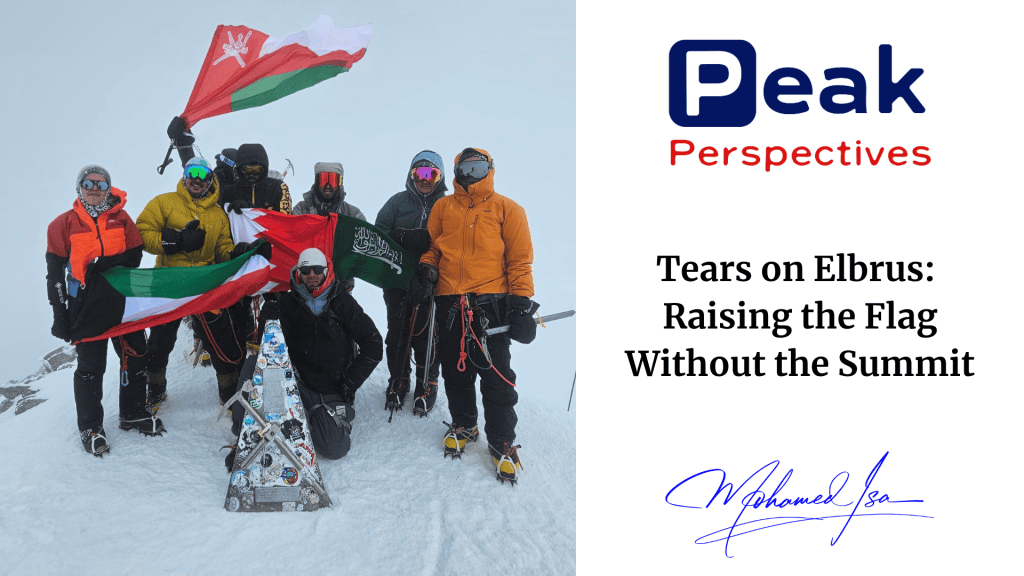
At 5,642 meters, Mount Elbrus is Europe’s highest peak and one of the coveted Seven Summits. For me, it was meant to be the third chapter in my quest to climb the tallest mountain on each continent. But on 1 August 2025, just two hours into the summit push, I made the hardest call a climber can make: I turned back.
In this article, I want to share the emotional highs and lows of that expedition, the leadership principles that guided my decision, and why I believe walking away sometimes takes more courage than reaching the summit.
Summit Day Begins in the Darkness
At 1:30 a.m., we were fully dressed for the summit. The ten of us were out fixing our ice axes onto our backpacks and trying to mount our crampons on our three-layer summit boots. Our Lead Mountain Guide, Ismail Kerimov, and his team were checking on all of us. The team’s spirit was high, and we were ready to take on Mount Elbrus, the highest mountain in Europe. We mounted our backpacks on the snowcat to make our journey past Pastukhov Rocks. We marched on. The moment we arrived at the designated location, we performed group prayers led by Ismail, who climbed Elbrus 157 times. Then, we began our uphill climb. It was freezing and windy. I did not think for a second to pull out my phone to take any pictures or videos.
The Day Elbrus Brought Me to Tears
On the morning before the summit day, I visualized summitting Mount Elbrus and proudly raising the flag of Bahrain with my colleague Musaab Hammadah, who climbed Elbrus in 2024. The picture was so vivid that I imagined holding the flag with Musaab and punching the air triumphantly. It felt so real that I sobbed and shed tears. As for the other time I shed tears, it was when I decided to turn back from the summit push after climbing for two hours. I suffered from a severe headache. It was a decidedly unfavorable sign. It was an indication of suffering from Acute Mountain Sickness (AMS). And that is not a good thing!
Choosing Safety Over the Photo I Dreamed Of
Most people associate mountaineering success with the summit photo. In my case, this photo was precious because I was supposed to include it in an upcoming book, Everest Inspiration, and my future talks about leadership. However, I had to choose between my safety and the summit photo. Pushing forward could have escalated my condition, requiring a rescue operation that would have jeopardized the summit push of the entire team, especially considering that there are no helicopters available to fly over Elbrus. I would have to be dragged down to a point where a snowmobile could pick me up for medical attention, and I did not want that.
The Headache That Made the Decision for Me
The headache started 30 minutes into the climb. I took out two Panadol tablets from the front pocket of my jacket. I hoped they would reduce the pain, but unfortunately, they did not. Two hours into the climb, the pain got worse. I started running thoughts in my mind. I thought about all the research I put into this expedition, the mental and physical preparation, and the money I invested. All of this could be wiped out with the decision turning away from the summit push. However, on the other hand, I knew it was the right decision to make. The mountain can wait.
Walking Away from a Year of Preparation
It all started when I trekked to Everest Base Camp in May 2022. Back then, I decided to pursue the Seven Summits Challenge, which involves climbing the highest mountain on each of the seven continents. I planned to climb summits in this order: Kosciuszko, Kilimanjaro, Elbrus, Aconcagua, Denali, Vinson, and ultimately, Everest. And if you think about it, it is a “plan.” Plans can change due to unforeseen circumstances. I felt frustrated when I returned. If I had climbed Elbrus this July, I would have attempted Aconcagua in Argentina in January 2026. However, looking on the bright side, I will start with experience when I return to Elbrus.
When Musaab Raised the Flag for Both of Us
When I returned to the base camp, I removed all my summit gear. I tried to sleep, but the thoughts of frustration would not let me rest. Additionally, I was worried about the team members as the weather forecast was unforgiving. I kept my eyes on the summit. It was invisible. Around 13:35, I heard the roaring sound of the snowcat. I hoped it was our team. I went outside, and I saw Riyadh Al-Hinai. He told me, “We faced a storm.” Then, I saw Said Al-Kalbani, who said, “Your decision to return was 100% right. We suffered in the storm.” Then Musaab arrived, and we hugged; he whispered, “I raised the Bahraini flag for you and me.” That was soothing.
The Rare Moment I Fell to My Knees
Shedding tears. I am not a person who sheds tears easily. I think this showed how much this expedition meant to me. The moment I turned to the right to go back, my tears flowed down my cheeks. With that decision, I felt my energy trampled. I fell on my knees twice on the way back. One year of planning and preparation was wiped out by one decision. When I go climbing, it is not about me; it is about inspiring the people around me, including my family and friends. It is about national pride. There is no feeling like it when you raise your country’s flag at international events or summits.
Resilience in the Face of a Relentless Storm
Regarding resilience, I would like to focus on our expedition team. In the first two hours of the summit push, three members returned, including me. As for the rest, they pushed the boundaries of what was possible. They faced a relentless snowstorm. Additionally, they witnessed two expeditions retreating from the summit push due to the harsh weather and low visibility. Our lead mountain guide, Ismail Kerimov, asked them, “Do you want to continue? If you want, I will take you to the summit.” And they did.
As for my heavy decision not to continue, it was logical. I did not want to be a subject of a rescue operation. The rescue is not only about descending safely to the base camp, but also to the village and then to the next town, 40 kilometers away, for medical attention. And as a bonus, now I have a story to tell my mum and prove that I do not take unnecessary risks when I climb mountains!
How Elbrus Has Reshaped My Approach to the Seven Summits
The Seven Summits is a long journey, and I am enjoying it. I am sure you have heard this popular phrase: it is not about the destination but about the journey. It is a journey of growth and countless lessons to learn. And I am meeting extraordinary individuals from around the world throughout it. And I am featuring four of them in my upcoming book, Everest Inspiration.
I consider not reaching the summit of Elbrus as a turning point in this journey. From now on, I will intensify my physical and mental preparation for upcoming summits. Not only that, but I also plan to invest in acclimatization masks and practice sleeping in tents during the mild winters in Bahrain. I must take my preparation to higher levels to avoid more tears in the mountains.
Lessons for Leaders, Climbers, and Dreamers
In my Everest Leadership talk, I offer this lesson: Have a plan but be flexible. This applies in our personal and professional lives as well as in the mountains. There are countless variables beyond our control. The best we could do is prepare well and execute to the best of our abilities. If we succeed in achieving our goals, it is time for celebrations. If not, it is time to take notes and prepare better for future endeavors. If you do not give up, you will reach up!
Raising the Flag, Even Without the Summit
The summit remained out of reach, but the flag still flew. It rose on the mountain that day, carried by the hands of a teammate and the spirit of our shared dream. Sometimes, the measure of a climb is not in the steps taken upward, but in the pride, resilience, and meaning we carry back down. On Elbrus, I turned around, but in that turn, I found a different kind of victory.
First published in Peak Perspectives, Mohamed’s LinkedIn newsletter, Edition #11, August 13, 2025.
Bring the Everest story to your leaders
Mohamed’s Everest Leadership keynote turns lessons like these into a working session for executive teams, conferences and leadership retreats.

