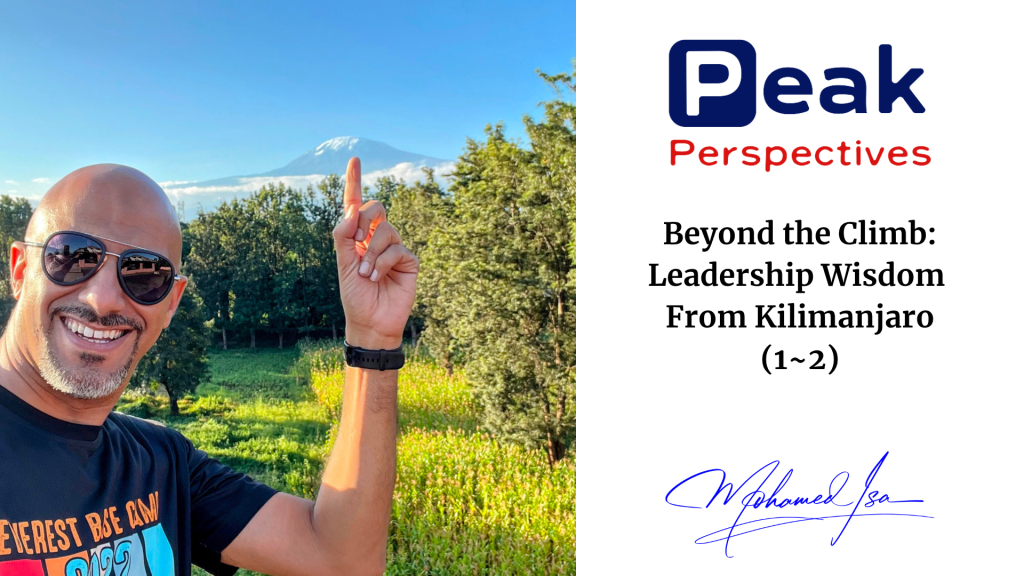
Part 1: The Climb That Tested Me
(From preparation to Lava Tower, resilience, humor, and the power of shared purpose)
The Climb That Couldn’t Come Soon Enough
When I decided to pursue the Seven Summits Challenge after reaching Everest Base Camp in May 2022, Kilimanjaro was the first summit I wanted to conquer. But the mountain made me wait.
In July 2022, I found a group planning to climb, but the timing clashed with my commitments. Then came 2023, and silence. None of the trekking companies I followed announced expeditions to Kilimanjaro. I grew restless and frustrated. I wanted momentum. That’s why, almost out of necessity, I climbed Mount Kosciuszko in January 2024, just to feel like I was moving forward.
So, when Wadi Adventures finally announced their Kilimanjaro expedition, I didn’t hesitate. I registered immediately. My name was first on the list.
Leadership Lesson 1
A clear goal doesn’t guarantee immediate progress, but it does anchor your patience. When progress stalls, great leaders don’t abandon the mission. They recalibrate, stay ready, and recognize the opportunity the moment it appears. I wasn’t late to Kilimanjaro; I was ready when the mountain called.
Training in the Shadow of Giants
Mentally, I had been preparing for Kilimanjaro since 2022. I studied the mountain in detail, watched countless YouTube videos, followed climbers on Instagram, and consumed stories from those who had walked the same path. I knew I would be facing a 5,895-meter challenge, and I wanted to understand every inch of it, the terrain, symptoms, and summit success rates.
Physically, I focused more on endurance than strength. I didn’t lift weights for this one. Instead, I laced up my shoes and walked kilometers upon kilometers. Twice, I even traveled to Nepal as part of my training. In April 2024, I hiked up to Poon Hill to witness the sunrise over the Annapurna Range. In June, I trekked from Chisapani to Nagarkot. Each trek was a rehearsal for Kilimanjaro. Every sunrise was a silent motivation.
Leadership Lesson 2
The real work of leadership often happens far from the spotlight.
Preparation isn’t glamorous. It doesn’t trend. But it’s what separates those who panic under pressure from those who persevere. Every kilometer I walked, every early morning in Nepal, that was leadership training in disguise.
Machame Route: Beauty, Brutality, and Brotherhood
When we arrived in Moshi, Tanzania, we followed the Machame Route. It’s famous for its steep ascents, dramatic scenery, and slower pace, which allows for better acclimatization. Over the course of six days, we journeyed through five distinct ecological zones, each more striking than the last.
Our group of ten climbers, six from Oman, two from Kuwait, one from Qatar, and I from Bahrain, bonded quickly. As the terrain changed, so did the altitude. And with it, the challenges. But what remained constant was the spirit of camaraderie.
Leadership Lesson 3
Diversity isn’t a challenge, it’s an advantage.
Ten climbers. Four nationalities. One mountain. When trust is built early, differences become strengths. Whether in business or on the trail, alignment matters more than uniformity.
Arrival: A Journey Before the Journey
Arriving in Moshi was an expedition in itself.
I flew from Bahrain to Dubai, then Dubai to Dar es Salaam, and finally to Kilimanjaro International Airport. After navigating baggage claims and security checks yet again, I was exhausted. But the 45-minute drive to the hotel began to restore me. Moshi was lush and green, a town humming with gentle energy.
I was the first one from the group to arrive. Soon after, Rashed joined me as my roommate for the next two nights. Rashed came well-prepared and well-supplied. His duffel bag was loaded with the internationally beloved Oman Chips. A small but joyful detail that felt like home, miles away from it.
Our hotel was a quiet oasis. And when the skies cleared, you could step onto the rooftop and see it: Kilimanjaro, towering, still, majestic.
When I saw the mountain for the first time, I whispered to myself:
Finally, we meet.
But Kilimanjaro wasn’t the only welcoming presence. The Tanzanian people were warm, joyful, and gracious. Their kindness made you want to return, not just to the country, but to the people.
Leadership Lesson 4
When employees treat customers like guests, the business takes care of itself.
The way the Tanzanians treated us should be the gold standard for any customer-facing team. Hospitality builds loyalty faster than any sales pitch ever could.
More Than a Summit
For me, climbing has never been about capturing a heroic photo at the top. It’s about bringing out the hero within.
Leaders who overcome physical mountains often return better equipped to face the metaphorical ones. I believe climbing is more than just a physical and mental endeavor. It’s a spiritual one. The slow, deliberate movement through unfamiliar trails becomes a form of meditation. You become acutely aware of your surroundings. As you begin to count your blessings more consciously, you appreciate the clean water back home, the warmth of a bed, and the ease of a hot shower.
And there’s another quiet gift that mountains offer: Connections.
In November 2024, on one of my treks, I met Jan from the United States. He was on a mission to visit every country recognized by the United Nations. When I met him, he had already reached 125 countries. Imagine the knowledge, cultural awareness, and global friendships someone like that carries.
Mountains attract people like Jan, curious, courageous, and connected. Conversations on the trail are deeper. More intentional. Less distracted. And those relationships often echo into meaningful moments long after the descent.
Leadership Lesson 5
Climbing builds leadership not just in muscle or mindset, but in meaning as well.
As we moved higher into thinner air, the path ahead grew more uncertain, and with altitude came adversity. But that’s where the true leadership lessons began to unfold.
Lava Tower: My Lowest Moment
Sleep was scarce during the Kilimanjaro expedition. On the first night at Machame Camp (3,010 meters), I shared a tent with Hussain Al Shimali from Kuwait. Some in the group assumed my sleeplessness was due to him, perhaps because he moved around too much or snored. For the record: he did not snore!
Others did, though. Two climbers snored like diesel-powered machines. I won’t name them to protect the guilty.
When we reached Shira Camp at 3,845 meters, the expedition leaders gave me my personal tent, hoping I’d finally get some rest. But my sleep deprivation persisted. I’d wake up between 1 and 2 a.m. and never fall back asleep.
The next morning, I took a single bite of my omelet sandwich and immediately felt a wave of nausea. I abandoned it, nibbling instead on a small pack of biscuits. My stomach churned.
That day, we ascended to Lava Tower, 4,630 meters. It was a tough gain: 785 meters of altitude in a single trek. By the time we reached our lunch stop, I was depleted. I took my seat inside the mess tent, but dizziness swept over me. I felt like vomiting, but couldn’t. It wouldn’t come out. I rushed outside to avoid creating a mess.
I was so drained, I scanned the volcanic ground for anything that resembled a pillow. I found a small rock and lay down, motionless.
That’s when Nahid Abdulla, our expedition leader and a certified first aid responder, stepped in. She didn’t panic. She didn’t call a group meeting. She acted. She called out for lemon slices and salt.
And Honest, one of the kind-hearted members of the kitchen crew, was the one who brought them to her, fast, without fuss. I chewed slowly, as instructed. Gradually, the nausea passed.
That night, we descended to Barranco Camp at 3,960 meters, a key part of the “climb high, sleep low” strategy. By morning, I felt like myself again.
Leadership Lesson 6
Great leaders don’t wait for a crisis to escalate. They recognize distress before it becomes a disaster.
Nahid’s quick thinking and Honest’s quiet execution were a masterclass in leadership at all levels. Because sometimes, it’s not just the person with the title who leads. Sometimes, the one who hands you a lemon slice saves your summit.
The higher we climbed, the more unforgiving the environment became. Lava Tower tested my body. Sleep deprivation tested my mind. But both would prepare me for what was still to come.
In Part 2 of this journey, I’ll take you into summit night, where darkness, fatigue, and altitude collide. What happens when your body says “no,” but your purpose says, “keep going”?
Keep reading. The mountain has more to teach.
First published in Peak Perspectives, Mohamed’s LinkedIn newsletter, Edition #7, June 3, 2025.
Bring the Everest story to your leaders
Mohamed’s Everest Leadership keynote turns lessons like these into a working session for executive teams, conferences and leadership retreats.

