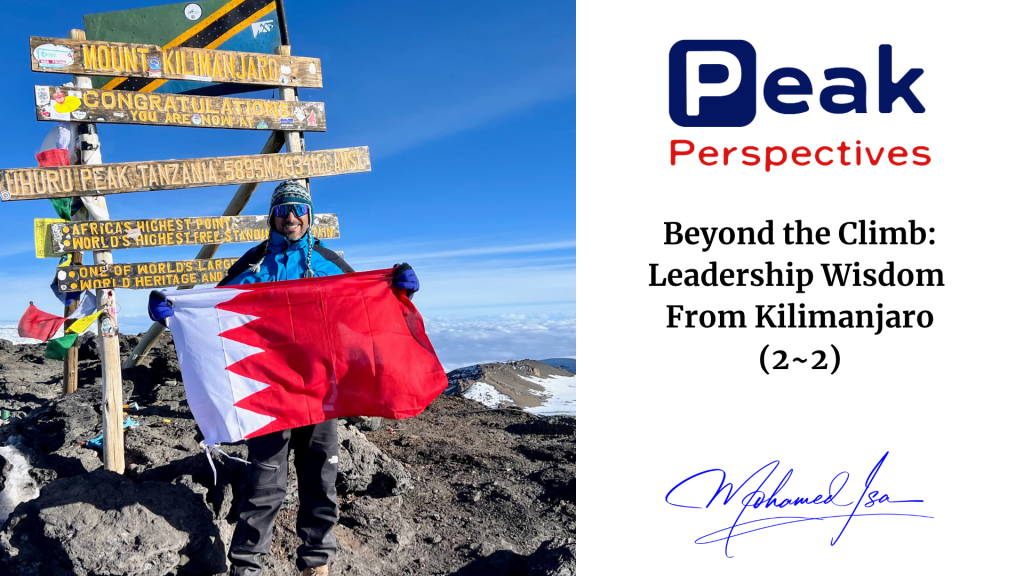
Part 2: The Summit That Shaped Me
(From Stella Point to Uhuru Peak: Resilience, Revelation, and the Power of Presence)
New to this story? Start with Part 1.
Mr. Kipara: A Name, A Bond
I never expected to leave Tanzania with a nickname that would stay with me forever:
Mr. Kipara.
We had just left Moshi and arrived at the Machame Gate (1,800 meters). After completing our paperwork and weighing our duffel bags, we began our trek through the lush forest. The trail was alive with sound and color, and even our first wildlife encounter: a black monkey darting between the trees.
An hour or so into the hike, one of our guides, Florence, looked at me with a wide grin.
“You are Kipara,” he said.
I laughed. “What’s Kipara?”
It means bald … in Swahili.
I smiled and replied, “I love it.”
Florence lit up.
“So, can we call you Mr. Kipara?”
“Absolutely,” I said.
From that moment on, it stuck. Not just with Florence, but with the entire Tanzanian crew and even our own group members. Every day, the team would sing a song they made up for me. Nearly 30 crew members would form a half-circle, clapping and singing: “Mr. Kipara, Mr. Kipara.”
They didn’t just sing my song. The Tanzanian crew had a soundtrack for the mountain, Hakuna Matata was its anthem. It wasn’t the Disney version. It was the real one, sung with rhythm and pride, echoing through the valleys.
Leadership Lesson 7
Humor and humility open doors that authority never will.
In a high-stress environment, laughter became our language. Mr. Kipara wasn’t just a nickname. It was a bridge between cultures, between hearts.
Running on Empty and Finding Light
Unlike my Everest Base Camp trek, Kilimanjaro offered no power outlets. That meant one thing: pack smart, and pack extra. Power banks became as essential as hiking poles, crucial for charging phones, watches, and cameras.
I came prepared with two power banks. But by the final stretch of the climb, even those were drained. I wasn’t alone; everyone’s batteries had run dry.
Thankfully, Abdulla Al Azmi from Kuwait handed me his power bank just when I needed it most. That final charge kept my phone alive long enough to capture the closing moments of the expedition.
But the real oversight wasn’t digital, it was practical.
I had forgotten to pack one essential item: a headlamp. A crucial tool for the summit night climb, when the darkness is absolute and every step depends on light.
Once again, Rashed, my roommate from the first two nights in Moshi, came through. He had brought a spare headlamp, and unlike many modern models, his ran on standard batteries, requiring no USB cables. Even better, he handed me a fresh pack of batteries, no questions asked.
That night, I climbed in the light because someone else had the foresight to carry it for me.
Leadership Lesson 8
Leadership isn’t just about what you carry for yourself. It’s about what you carry just in case someone else can’t.
Rashed’s headlamp and his quiet act of generosity reminded me that leaders don’t always announce themselves. Sometimes, they simply show up prepared and pass the light forward.
The Summit Night: Pole Pole in the Dark
By the time the summit night arrived, I was running on five nights of broken sleep and not a single minute the night before. At 10:00 PM, we gathered at Barafu Camp, zipped up our jackets, adjusted our headlamps, and began the long march to the top.
The goal was clear: reach Uhuru Peak between 6:00 and 6:30 AM. The air was thin, the path steep, the darkness absolute.
We moved as a group pole pole, as they say in Swahili. Slowly, slowly. That wasn’t a suggestion. It was a survival strategy.
The slope grew steeper, at 30 or 40 degrees, and then we hit it: the never-ending zigzag path leading to Stella Point. I began to unravel.
I was walking like a ghost, exhausted, drained, hollowed out. I asked our lead guide, Aggrey, for a break. He nodded. I asked for another. He agreed again. But when I asked for a third stop, he hesitated.
“If we take another break,” Aggrey said firmly, “the other groups will catch up. It will be crowded. We must move on.”
And I didn’t blame him. Looking down the trail, I saw a winding line of headlamps, slowly advancing up the mountain. A glowing snake of climbers inching upward. We weren’t alone on this mountain. And space at the top was limited.
“I’ll catch up,” I told them.
At least, I hoped I would.
But I wasn’t left behind.
Lameck, one of our Tanzanian guides, stayed with me. So did Hamad Al Riyami from Oman. Hamad was relentless in his support. He urged me to keep my eyes open. “Don’t sleep, Mohamed,” he said over and over. “Stay with us.”
At one point, I whispered, “I’m thirsty.”
He pulled the tube from my water pack.
Nothing. Frozen.
“Try mine,” he offered.
It was frozen too.
Sleep-deprived, dehydrated, and moving through cold blackness.
I kept walking.
Noticing how much I was struggling, Lameck gently offered to carry my backpack.
Under normal circumstances, I would’ve declined immediately.
Pride would’ve answered for me. But not that night.
That night, I was dying on my feet.
I handed it to him.
I continued walking, pole pole, not by choice, but by necessity.
My legs moved from memory.
My mind was dimmed.
There was no scenery, no sense of time.
Just cold, altitude, and the grind of willpower.
And then, finally, we reached the wooden sign of Stella Point.
5,785 meters above sea level.
Lameck looked at me and spoke gently:
“Mr. Kipara, if you cannot continue, you can stop here, and we will go down.
They will give you a certificate for reaching Stella Point.”
I looked at the sign.
I looked at the sky.
I looked inward.
And I thought to myself:
I didn’t come all this way to stop here.
“How long to the summit?” I asked him.
“One and a half kilometers.”
“Then let’s continue,” I said.
Before we moved, I looked to my right.
And there it was, the most beautiful sunrise I’ve ever seen.
The sun broke between the snow and the clouds.
Golden light spilled across the icy slopes in silence.
It wasn’t just light. It was a moment. The kind that freezes time.
I didn’t say a word.
I just smiled.
And quietly, I laughed inside.
“They missed this.”
We kept walking.
Somewhere along that final stretch, we met the rest of the group coming down.
Aggrey was leading them.
I embraced him.
“Look at that beauty,” I told him, pointing toward the glacier that had captured my gaze.
“This is what I longed to see for the last two years.”
What I didn’t say, what I couldn’t say at the time, was that my eyes had quietly shed tears.
Tears for the beauty I had witnessed.
Tears for the wish I had just fulfilled.
Tears for the truth I carried:
That this glacier, like many others, is disappearing.
A marvel.
A warning.
A farewell.
Leadership Lesson 9
Sometimes leadership means walking beside someone, not in front of them.
The quiet guides who adjusted their pace for mine carried more than my pack, they carried me to the summit.
Uhuru Peak: The Roof of Africa
And then, there it was.
The wooden sign.
Uhuru Peak.
The roof of Africa.
5,895 meters above sea level.
I stood before it, not rushing, not posing.
I took the moment in.
A few pictures.
A quiet smile.
A deep breath.
And then, I turned and embraced Lameck, the guide who had stayed with me, who had carried my backpack, who had walked each slow step by my side.
“Thank you,” I said.
“For everything.”
We didn’t linger.
The summit isn’t a place to stay.
It’s a place to touch and to remember.
And so, we began our descent.
And as if the mountain hadn’t already given me enough, I was treated to another scene.
The sun again, rising between snow and clouds.
But this time, from a different angle.
With a different weight.
A different feeling.
This time, the feeling was:
“I made it.”
Leadership Lesson 10
The best views aren’t just rewards, they’re reminders.
Leaders who endure the climb appreciate the horizon with deeper clarity.
Mount Kilimanjaro tested my stamina more than I thought.
It tested my patience, my humility, and my willingness to receive help when I needed it most.
I didn’t reach the summit alone, and I didn’t leave it unchanged.
The mountain reminded me of something I already knew, but had to experience again to believe:
Leadership isn’t about racing to the top. It’s about how you climb with others, for others, and sometimes because of others.
I left with tired legs, a full heart, and a name I’ll never forget:
Mr. Kipara.
First published in Peak Perspectives, Mohamed’s LinkedIn newsletter, Edition #8, June 10, 2025.
Bring the Everest story to your leaders
Mohamed’s Everest Leadership keynote turns lessons like these into a working session for executive teams, conferences and leadership retreats.

