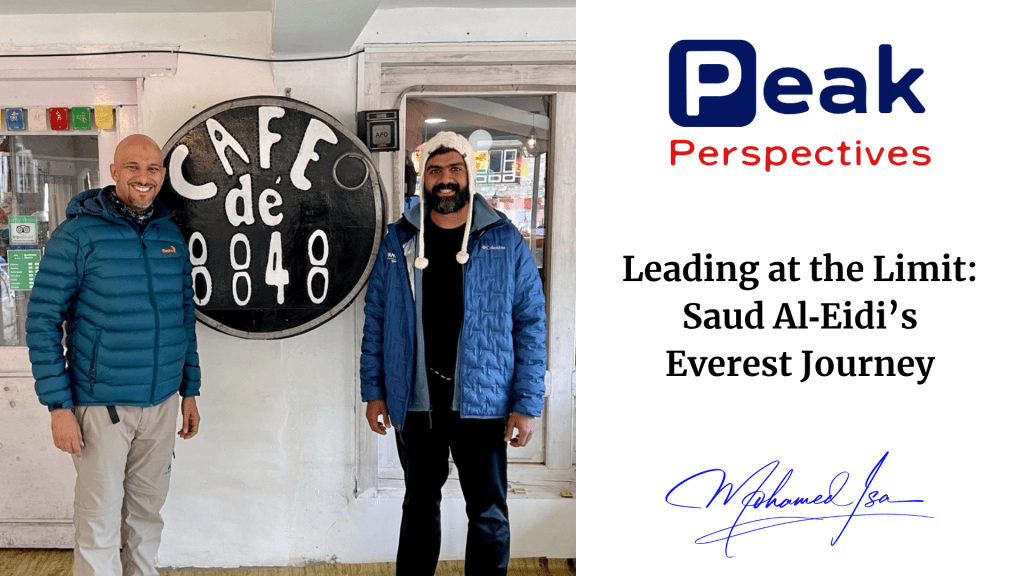
On 8 May 2022, I walked into the 8848 Café in Namche Bazaar, the gateway to Everest, to catch my breath.
I was trekking to Everest Base Camp with Kawthar, Mai, Hassan, Ahmed, and Hamad. We had earned that stop. And as fate would have it, Saud Al-Eidi was sitting there too. He was leading his own expedition to Base Camp.
We started talking. I was excited. I was also unsure of what was waiting for me higher up the trail. At one point, Saud looked at me and asked:
“How do you feel about this challenge?”
I did not hesitate.
“I will reach EBC on my feet. If not on my feet, on a yak’s back or a horse’s back. And if I can’t make it this time, I will return again and again until I finish it.”
He smiled. Not just with his mouth, but with his eyes. A knowing smile.
I did not understand that smile at the time. It took me a whole documentary to understand it.
The Man at the Next Table
Three years before that café, on 23 May 2019, at 7:30 in the morning, Saud stood on the summit of Mount Everest and raised the Saudi flag.
The summit took one morning. Getting there took six years of training and planning. Then 60 days in the Himalayas: Base Camp, altitude sickness, bitter cold, and the slow push into the Death Zone.
This is what he wrote on Instagram afterwards:
“Thanks to God, after six years of training and planning and 60 days spent in the Himalayas, I reached the top of the world… Thank you for believing in me, and thank you all for your prayers and support, friends.”
Saud Al-Eidi, on Instagram
Read it again. He does not thank people for the summit. He thanks them for believing in him. Six years of belief, from people who could not climb a single meter of it for him.
Saud is among the first Saudis to stand on top of the world. Farouk Al-Zoman opened the trail in 2008. Prince Bandar bin Khalid followed in 2012, and Raha Moharrak in 2013, the first Saudi woman to reach the summit. In 2019, Saud and Mona Al-Shihab both made it on separate expeditions. What a year for Saudi mountaineering!
When Saud returned to Riyadh, Prince Bandar bin Khalid bin Fahd, himself an Everest summiteer and Chairman of the Saudi Climbing Federation, welcomed him publicly. Mona was celebrated too. And it is hard to miss the timing. Saudi Arabia’s Vision 2030 asks a whole nation to think bigger, engage globally, and lead in every sector. A Saudi flag on Everest says the same thing without a single word.
What the Smile Meant
Later, I watched his documentary, Mount Everest 8848. And there it was.
On his own summit push, others turned back. Saud pushed on alone. Determination and mental strength carried him the rest of the way to the top.
So when a bald man from Bahrain sat in a café and promised to reach Base Camp on his feet, on a yak, or on his second, third, or fourth attempt, Saud was not smiling at bravado. He recognized something he knew very well. The refusal to surrender.
He had lived it at 8,848 meters. I was about to test it at 5,364.
The Summit Was Not the Finish Line
Most people would frame the Everest photo and retire the boots. Saud did the opposite.
Since 2019, he has climbed Kangchenjunga, the third-highest mountain in the world. He founded PANGAEA Adventure Club and leads it as CEO, running eco-tourism experiences across Saudi Arabia and in more than 20 countries. He partners with the private and government sectors on sustainable tourism. As List Magazine put it, he has moved from Everest climbing to eco-tourism pioneer.
In his own words:
“I’m Saud Al-Eidi: a traveler and mountaineer. I began my journey around the world in 2015, and since then, I have visited 88 countries and climbed approximately 20 mountains globally. The most significant of these was Mount Everest, the highest peak in the world, which I summited in 2019. Following this achievement, PANGAEA transformed into an official travel company offering various experiences. I live in the city of Khobar and work with passion from there at PANGAEA. I am proud of the amazing team I work with.”
Saud Al-Eidi, PANGAEA Adventure Club bio
Eighty-eight countries. And notice where the sentence ends. Not on Everest. On his team.
Five Lessons from Saud’s Climb
1. Vision needs patience. Six years for one morning at the top. Most of us want the summit photo. Very few of us want the six years. The leaders who last are the ones who sign up for both.
2. Plan like your life depends on it. On Everest, it does. Nobody climbs it on impulse. It takes precise preparation, risk management, and the ability to change the plan when the mountain changes the conditions. I spent more than 11 years as a CFO, and I can tell you the boardroom has its own Death Zone. It is the quarter when the market turns against you overnight. The leaders who survive it planned for it before it arrived.
3. Resilience shows up when others turn back. Anyone can keep going when the whole team is moving. The real test is the moment you look around and you are the only one still climbing.
4. The flag is bigger than the climber. Saud carried more than his own dream up that mountain. He carried the hopes of a nation and a new Saudi generation. Great leaders represent something larger than themselves.
5. The summit is a starting point. He turned one personal triumph into a company, a team, and a movement. True ambition is measured by what comes after success.
Back to the Café
I reached Base Camp. On my feet. The yak was spared.
But I still think about that café in Namche Bazaar. Saud did not give me a speech. He did not hand me a framework or a list of tips. He asked one question, listened to the answer, and smiled.
Leadership is not always about big speeches or grand gestures. Sometimes it is a quiet smile that says:
“I see the fire in you. Now go and climb your mountain.”
So, let me ask you the question I ask every audience:
What Is Your Everest?
What is the one peak you are determined to reach in the next one to two years, professionally or personally? And are you ready for the six years it might really take?
See you at the Summit!
Sources: List Magazine feature on Saud Al-Eidi and his documentary Mount Everest 8848.
First published in Peak Perspectives, Mohamed’s LinkedIn newsletter, Edition #10, July 1, 2025.
Bring the Everest story to your leaders
Mohamed’s Everest Leadership keynote turns lessons like these into a working session for executive teams, conferences and leadership retreats.

