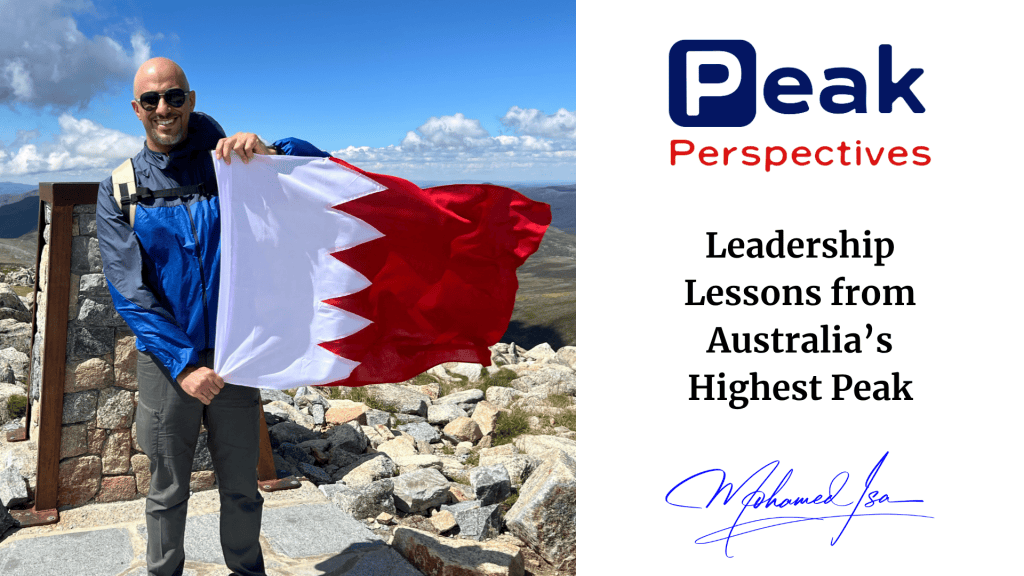
When You Start, Everything Changes
The moment I planted the Bahraini flag atop Mount Kosciuszko, a wave of emotion surged through me: joy, pride, and a deep sense of achievement. I was the first Bahraini to do so.
All the pain of the climb faded. In that instant, one thing echoed in my mind:
“One summit down, six more to go.”
The journey had officially begun.
On 10 January 2024, I officially began my Seven Summits Challenge, climbing the highest mountain on each continent.
Beyond the Postcard: The Road to the Summit
Climbing Mount Kosciuszko might not sound extreme. It stands at 2,228 meters, modest by Himalayan standards. But getting there was no walk in the park.
I had to fund the entire trip myself. The airfare alone was over USD 2,400: Bahrain to Dubai to Brisbane. Add to those internal flights, nights to recover, a car rental, and a 2.5-hour drive to Thredbo. And yes, it was my first time driving on the right side of the road. That alone felt like a mission.
What stands out in my memory, however, is the beauty of the journey. The drive from Canberra to Thredbo was like entering a living painting: rolling green fields, massive boulders, warning signs for koalas and kangaroos (though I saw none), and the elegant deer that greeted me near Thredbo.
And then there was Lake Jindabyne. I stopped by it twice, on my way in and again on my way out. Its still waters mirrored the surrounding trees and hills, creating a tranquil view that felt like nature whispering: “Pause, and take this in.”
The Trail Wasn’t What I Expected
They say Kuzi (as the locals call it) is just a walk to the summit. But that’s from an Australian perspective. This was a genuine climb for someone from Bahrain, a flat land with barely any hills.
I decided not to take the cable car. I wanted to do it the hard way, footstep by footstep. No group. No guide. I only had the advice of my Omani friend, Suliman Al Naabi, who had completed the Seven Summits Challenge earlier:
“Put your boots on and follow the people on the trail.”
Only problem?
There weren’t many people on the trail that day.
I had to trust the signs, which at times were confusing. I relied on instinct, asked a few hikers, and kept walking and walking on Merritts Nature Track.
But those little streams along the way? A blessing. I drank from them with my hands, cooled my face, and filled my bottle. They reminded me:
“You don’t need to carry everything. Sometimes, nature provides just enough.”
Fuel for the Final Push
Before making the final push to the summit, I stopped at Eagle’s Nest, the highest restaurant in Australia.
I sat by the window, looking out over the Snowy Mountains, and ordered a simple pizza. It wasn’t gourmet by any means. But at that moment, it felt perfect.
Eating pizza at 1,937 meters, with the summit still ahead of me, felt like a quiet ritual. It was a small reminder that sometimes leadership and life are about finding small comforts before big challenges.
The Leadership Lessons from the Ascent
1. Every Mountain Has Its Personality
Just like every business. Context is everything, whether you’re leading a turnaround or scaling new heights. Kuzi wasn’t Everest or Kilimanjaro, but it taught me not to underestimate. Simulation is never equal to the real thing.
2. You Don’t Always Get a Second Shot
This was a one-day summit, no tea houses. No acclimatization. In business, too, you sometimes get just one window. You either go for it or miss it entirely.
3. You Must Be Your Own Cheerleader
I wasn’t part of a team here. I had no one clapping me on. And yet, I kept going. Leaders often find themselves in lonely positions. You cannot afford to wait for applause.
4. Build Your Backup Plan, Then Go All In
I had a Plan B, summit on Day 2 if I did not make it on Day 1. But when the conditions were right, I seized the moment. Leadership is about balancing preparation with decisive action.
5. Celebrate Small Joys (Even Toilets!)
On my way back, I made it a point to visit the highest toilet in Australia. Silly? Maybe. But it reminded me to find humor and humanity, even when you’re exhausted.
6. The Wrong Tools Will Hurt You
I did not wear my favorite boots because I could not find them before my flight. I wore another pair, and I paid the price. In leadership, ill-suited tools, mismatched teams, or outdated systems can slow you down or derail you.
7. Nature Clarifies What Noise Obscures
The solitude, silence, and wind all worked like meditation. It helped me reconnect with myself. Leadership requires clarity, which often means stepping away from the boardroom/corner offices to hear what really matters. Walk around the company, meet employees and customers.
Reflections from the Right Side of the Road
After the summit, I returned to my hotel and collapsed on the bed. The next morning, I retook a stroll by the lake. That’s when I saw a traffic sign that made me laugh out loud:
“No Entry. No Exit.”
Was it a metaphor for leadership?
For life?
For how far I had come?
I do not know.
But it stuck with me.
Before leaving Thredbo, I stopped at a small supermarket to buy a chocolate bar, my little reward for the climb. When I finally opened it back at the hotel, I discovered it had expired eight months ago.
I laughed. After all that effort and elevation, even chocolate has its own way of humbling you. Leadership can feel like that, too: unexpected wins, strange setbacks, and surprises you must swallow.
Final Thought
I was not the fittest that day.
But I showed up.
I endured.
I adapted.
For example, when I leapt from a credit analyst to CFO of a growing company, uncertain but determined, I realized that you grow by saying yes to the climb, even when you are unsure what is waiting at the top.
Kuzi was not just a mountain.
It was a mirror.
And I saw someone I could believe in.
Your summit does not need to be tall to be transformative.
Whether you are chasing a personal goal or leading a team through uncertainty, the first step is what changes everything.
What is your Kuzi?
Footnote: The name “Jindabyne” is derived from an Aboriginal word, initially spelled “Jindaboine,” which is believed to mean “valley” or refer to a specific valley in the region. The town is in a valley near the Snowy Mountains of New South Wales, Australia, and overlooks Lake Jindabyne. The area is traditionally associated with the Ngarigo people, the Indigenous custodians of the Snowy Mountains region. The name reflects the town’s geographical setting and its cultural heritage.
First published in Peak Perspectives, Mohamed’s LinkedIn newsletter, Edition #3, April 29, 2025.
Bring the Everest story to your leaders
Mohamed’s Everest Leadership keynote turns lessons like these into a working session for executive teams, conferences and leadership retreats.

